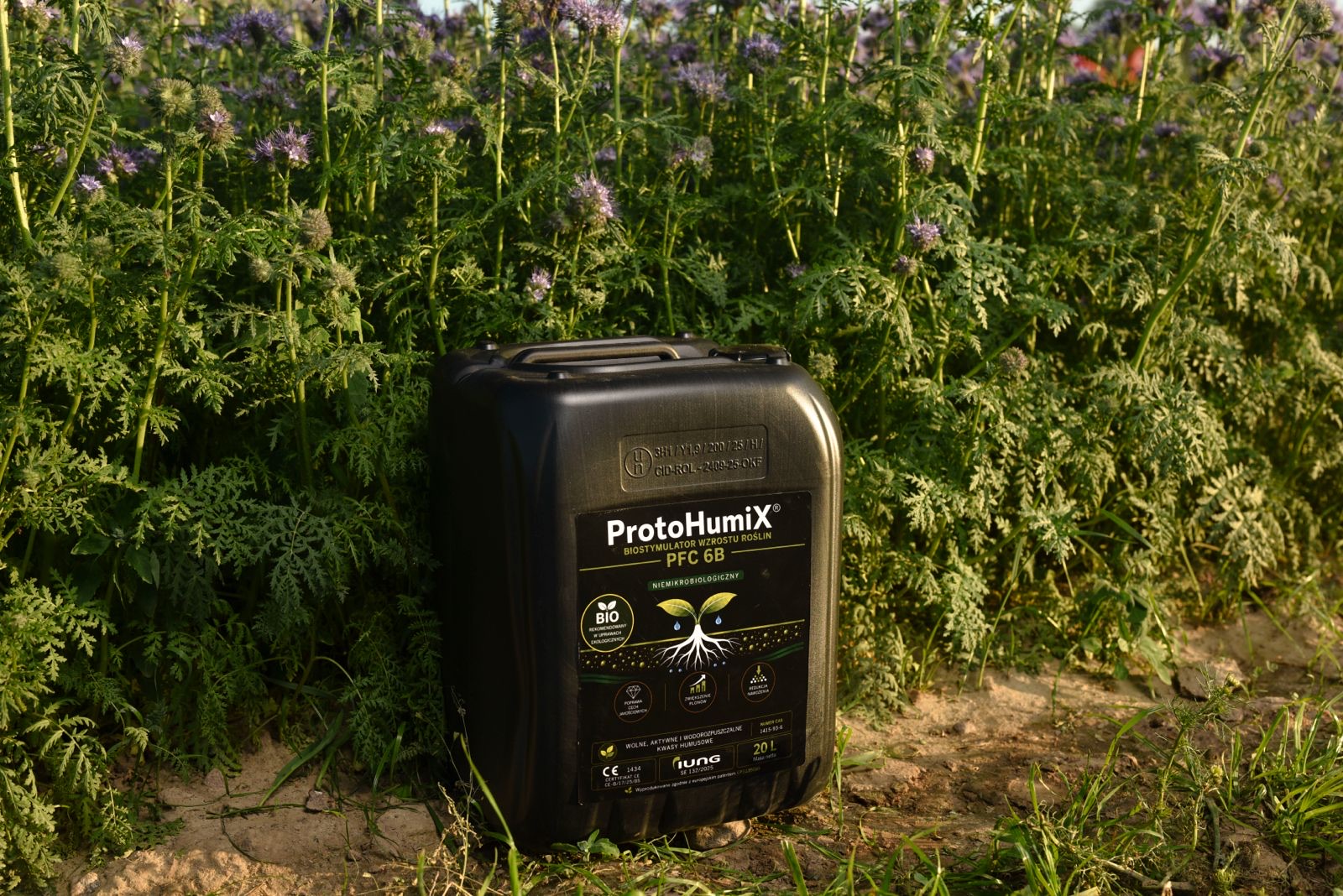
 20 l
20 lPlant biostimulant PFC 6(B)
ProtoHumiX® Biostimulant PFC 6(B) — 20 l
A 20 l canister — the pack for large farms. Lowest price per litre in the biostimulant line. Orders above 10 units and IBC 1000 l containers are quoted individually.
Volume discounts
| Number of packages | Net price / pkg. | Net price / 1 l |
|---|---|---|
| 1–9 | 2100,00 zł | 105,00 zł |
| 10 | 1837,50 zł | 91,88 zł |
The quantity threshold applies to a single product and a single size; variants are counted separately. Discount applied automatically in the cart.
- Permitted in organic farming — IUNG-PIB SE/132/2025
- Certified and manufactured in the European Union
- Thirty-two documented field trials from 2014–2023
Application and dosing
The dose depends on the purpose: in-season treatments, seed treatment or tuber treatment. Each of the six crops on the registered label has a full season program: timing, dose per treatment, season total and the number of hectares per 20 l canister.
Season program — foliar spray
Crops on the registered label
| Crop | Treatments and stages | Dose per treatment | Season total | 20 l covers |
|---|---|---|---|---|
| Cereals — wheat, rye, oats, barley, millet | 3–6 leaves → after tillering (stem elongation) | 0.7 · 0.7 l/ha | 1.4 l/ha | 14 ha |
| Rapeseed — winter and spring | first true leaves → onset of rosette formation → start of budding | 0.7 · 0.7 · 0.7 l/ha | 2.1 l/ha | 9.5 ha |
| Maize | 4–6 leaves → tassel formation | 1 · 1 l/ha | 2 l/ha | 10 ha |
| Sunflower | 2–3 leaves → 4–5 leaf pairs → after 15 days | 0.7 · 0.7 · 0.7 l/ha | 2.1 l/ha | 9.5 ha |
| Soybean and beans | 2–3 leaves → start of budding → start of flowering (recommended, optional) | 1 · 1 · 0.7 l/ha | 2–2.7 l/ha | 7–10 ha |
| Potatoes | 5–7 leaves → after 30 days | 1.4 · 1.4 l/ha | 2.8 l/ha | 7 ha |
Spray in 200–250 l of water per hectare (potatoes 250–300 l). The same solution can be used for watering: the dose for leaf and root is the same.
Vegetables, orchards, vineyards, perennials, seedlings, lawns, hemp and flax: an advisor will set the dose.
Applications requiring a specific concentration
| Application | Concentration / dose | Notes |
|---|---|---|
| Seed treatment | 0.3 l / 1000 kg of seeds | Soak for 6–12 hours or mechanical treatment |
| Tuber treatment (potato) | 300–400 ml / 1000 kg of tubers | Before planting |
| Microgreens | 1–2 l / 1000 l of water (0.1–0.2%) | Spray seeds and sprouts, repeat every 48 hours |
Dose calculated per mass of seed and seed tubers or per volume of water: the water volume follows from the technology (seed treatment equipment, tank), not from the field area.
The product can be mixed with many plant protection products — the user is responsible for testing the mixture before use. Add ProtoHumiX® to the tank last.
Storage and shelf life
- The product retains its properties in the range from -20°C to +40°C. Keep it in the original, tightly closed packaging, away from direct sunlight. The product freezes below 0°C — after thawing and mixing it retains its usable properties.
- Shelf life: 36 months from the production date. Batch number and production date are on the packaging.
Frequently asked questions
How long does delivery take?
Orders usually ship within 3–7 business days from the payment being credited, by courier within Poland; personal pickup by arrangement is also possible — free of charge. Delivery cost: 34 PLN net per parcel, and from 60 litres of total order volume, pallet shipping at 189 PLN net; the number of parcels and the full cost are shown in the summary before you place the order.
Can I order more than 10 units?
Yes. Orders above 10 pcs and IBC 1000 l containers are priced individually. Contact us via the form and tell us the quantity you need.
Does the product have the certificates required in the EU?
Yes. Both products carry a CE certificate under EU Regulation 2019/1009 (biostimulant PFC 6(B) / soil improver PFC 3(B)). See the full list on the “Certificates” page.
What's the difference between PFC 6(B) and PFC 3(B)?
PFC 6(B) is a foliar biostimulant applied to plants; its CE declaration reads: “Quality traits: increased yield and accelerated plant growth.” PFC 3(B) is a soil improver applied to the soil: it improves soil structure and water retention.
Will I get a VAT invoice?
Yes. The VAT invoice is issued electronically after payment confirmation and sent to your e-mail address, with submission to KSeF. The rate for our products is 8%. To get an invoice for a company, tick the invoice option in the order form and provide the company name and tax ID (NIP) or, for a company from another EU country, the EU VAT number. For a group purchase, write to us and say whether you prefer one combined invoice or separate ones.
What if the product doesn't suit me?
A consumer has fourteen days from receiving the goods to withdraw from the contract without giving a reason — a statement to info@protohumix.eu is enough. Return the goods within the following fourteen days, in the original, unopened packaging; the cost of the return is borne by the customer. The right of withdrawal does not apply to purchases made within a business activity or after the packaging has been opened. The full terms are in the terms of sale.