ProtoHumiX®

Plant biostimulant PFC 6(B) and soil improver PFC 3(B)

Extract
of humic acids

In the extract, humic acids keep the acid form in which nature shaped them.

Permitted in organic farming (EU)

  • Certificates: CE · IUNG-PIB · EASY-CERT
  • Manufactured in the European Union
  • Field trials 2014–2023, seven countries

Origin

Active fractions from brown coal

Humic acids form through humification — the slow transformation of plant matter — and lie ready in brown coal. The active fractions pass into the extract; the rest stays outside it.

Acid form
The one in which humic substances occur in soil, in peat and in brown coal. The acid groups stay as they were in the raw material.
Physical purification
A process run at low temperature, without caustic substances, described in the public patent EP3135655B1.
Active fractions
The label describes them as active, water-soluble humic acids. Their typical content is given in the composition on the product page.
Mechanochemical reactor in which the extract is physically purified

Purity

Content of four elements in ProtoHumiX®, measured in the laboratory, against the CE thresholds, in mg/kg of dry matter.

ElementResult (mg/kg d.m.)EU thresholdShare of threshold
Lead (Pb)2.23<1201.86%
Mercury (Hg)<0.050<1<5%
Arsenic (As)<0.050<40<0.13%
Cadmium (Cd)<0.050<1.5<3.33%

The values describe the typical composition of the extract; individual batches may differ from it.

CE · IUNG-PIB · EASY-CERT

Quality

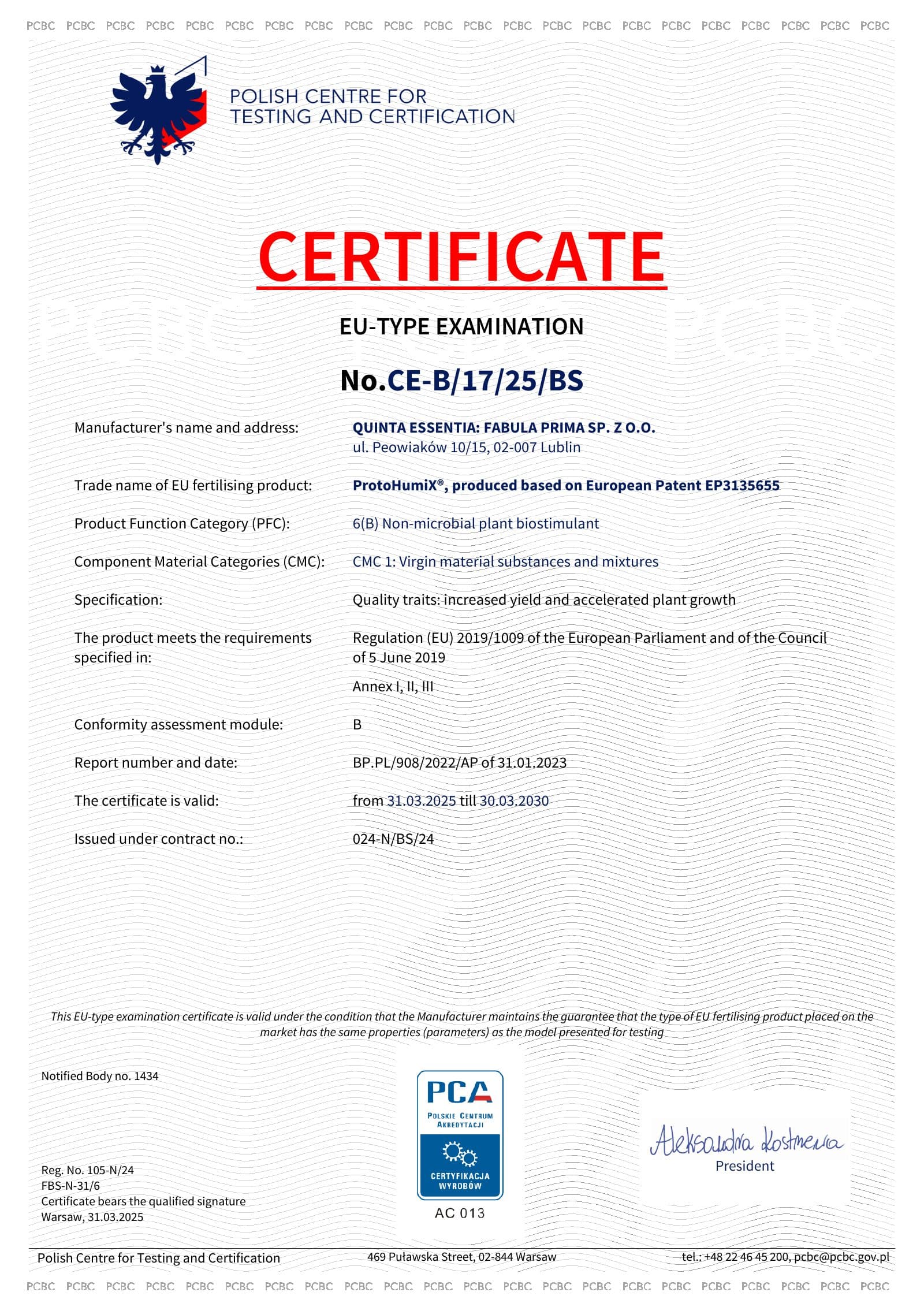
CE certificate — two categories

Plant biostimulant PFC 6(B) and soil improver PFC 3(B) under Regulation (EU) 2019/1009, each with its own specification.

IUNG-PIB — reference SE/132/2025

Qualification Certificate issued by the Institute of Soil Science and Plant Cultivation. Approval for organic farming in Poland; the entry is in the institute's public register.

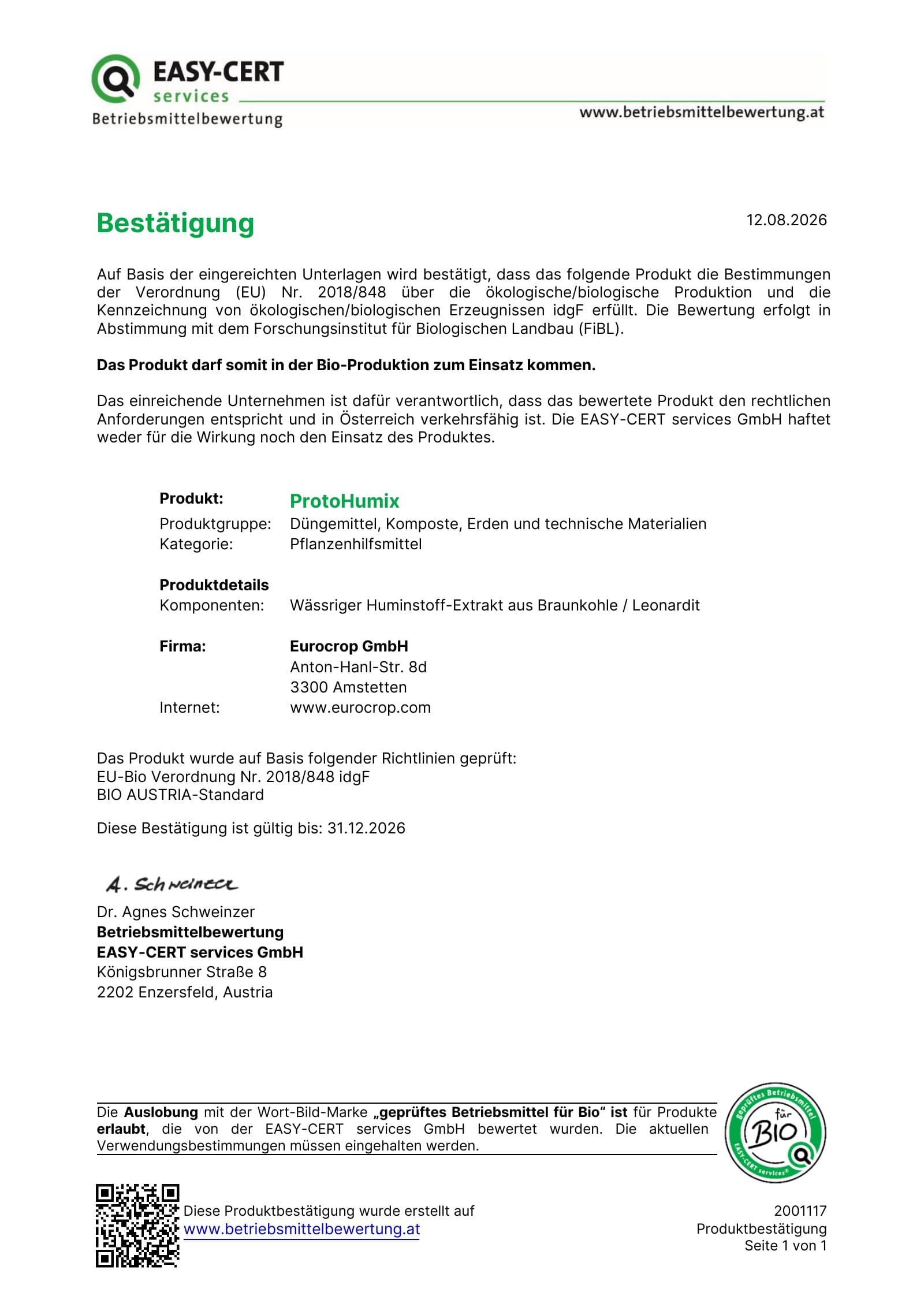
EASY-CERT — DACH region

Validation allowing the product to be used in organic farming in Austria.

Scan of the CE certificate for plant biostimulant PFC 6(B)
Scan of the IUNG-PIB qualification certificate No SE/132/2025
Scan of the EASY-CERT validation for organic farming in the DACH region

ProtoHumiX®

Areas of use

Plants and soil: two certified lines, plant growth biostimulant and soil improver. Animal feeding: feed material.

Plants and soil

Biostimulant PFC 6(B) acts on the plant, soil improver PFC 3(B) on the soil.

The biostimulant solution is sprayed or used to water the plants.

  • CE certificate declarations

    Plant biostimulant PFC 6(B) has the following specification on its certificate: “Quality traits: increased yield and accelerated plant growth.” Soil improver PFC 3(B) has its own, seven-item specification: from soil fertility and structure to reduced mobility of heavy metals.

Composition and specification on the product page

Animal nutrition

Feed material 13.10.2: a component of the daily ration.

  • Feed label declaration

    One sentence: supports the proper functioning of the digestive tract. Feed material 13.10.2 (Regulation (EU) No 68/2013) — a natural source of humic substances, given as a component of the daily ration.

Feed line on the product page

Questions & answers

What do humic acids help with?

Plant biostimulant PFC 6(B) has one specification on its certificate: “Quality traits: increased yield and accelerated plant growth.” Soil improver PFC 3(B) has its own, seven-item specification: from soil fertility and structure to reduced mobility of heavy metals. The size of the effect in the field is documented by field trials, each with its crop, country and year.

Farm results

How and when should humic acids be applied?

Dose and timing depend on the crop and growth stage. The PFC 6(B) biostimulant page in the shop gives the full season program for six crops (how many litres per hectare, at which stage and how many times). For other crops, an advisor chooses the dose. Seed and seed-tuber treatment is calculated separately, per tonne of material.

Shop

Are humic acids allowed in organic farming?

Yes. IUNG-PIB Qualification Certificate No SE/132/2025 approves ProtoHumiX® for organic farming in Poland (the entry is in the institute's public register), and the EASY-CERT validation covers Austria.

Certificates

Should seeds be treated with humic acids?

Seed treatment is calculated per tonne of seed and a foliar spray per hectare, so treatment costs a fraction of a spray. Treatment dose: 0.3 l per 1,000 kg of seed material, soaking for 6–12 hours or mechanical treatment; seed potatoes have their own dose.

What are the side effects and contraindications?

Application follows the dose recommended for the crop; a higher dose raises the cost of the treatment. If you have a safety question about a specific crop, ask us directly.

Contact

How do I choose humic acids — is this the same as humate or biohumus?

These are three different things. Biohumus is vermicompost: organic matter processed by earthworms. Potassium humate is a salt of humic acid: it dissolves well and brings an additional potassium cation into the soil. Our extract stays an acid. Products are compared by composition, fractions and what the manufacturer can document.

Where to buy and how much does it cost?

In the shop — two lines, plant biostimulant PFC 6(B) and soil improver PFC 3(B), in three pack sizes: 1, 5 and 20 l. The price per package drops from ten units of one variant.

Shop

Can I tank-mix ProtoHumiX® with what I already use?

The product can be mixed with many plant protection products. Checking the specific mixture before treatment is the user's responsibility: there are too many possible formulations to test every one. The label gives one rule: ProtoHumiX® goes into the tank last.

A jar test settles the doubt: mix in the sprayer's proportions and let it stand for a quarter of an hour. No clumps or sediment means the mixture is physically compatible.

More about humic acids

How the process differs from other production methods, explained in full.

What sets ProtoHumiX® technology apart from other production methods?

A process set up to extract only the active substances, while keeping every available fraction.

Technology: extraction that preserves the acid form